




Feb 9 2026 |
Independent Medical Exams in Ontario Injury Claims: What to Expect and How to Protect Yourself
If your insurer has scheduled an independent medical examination as part of your Ontario accident benefits claim, you are likely wondering what it means, what you are required to do, and whether it can hurt your claim. These are exactly the right questions to ask before you walk through that door.
Despite the word ‘independent’ in its name, an IME examiner is selected and paid by the insurer. The resulting report is routinely used to justify benefit reductions, claim denials, or placement of your claim into the Minor Injury Guideline. Understanding the process before it happens is not optional. It is essential.
For a full overview of how Ontario accident benefits and tort claims work, visit the personal injury law page at zaylaw.com.
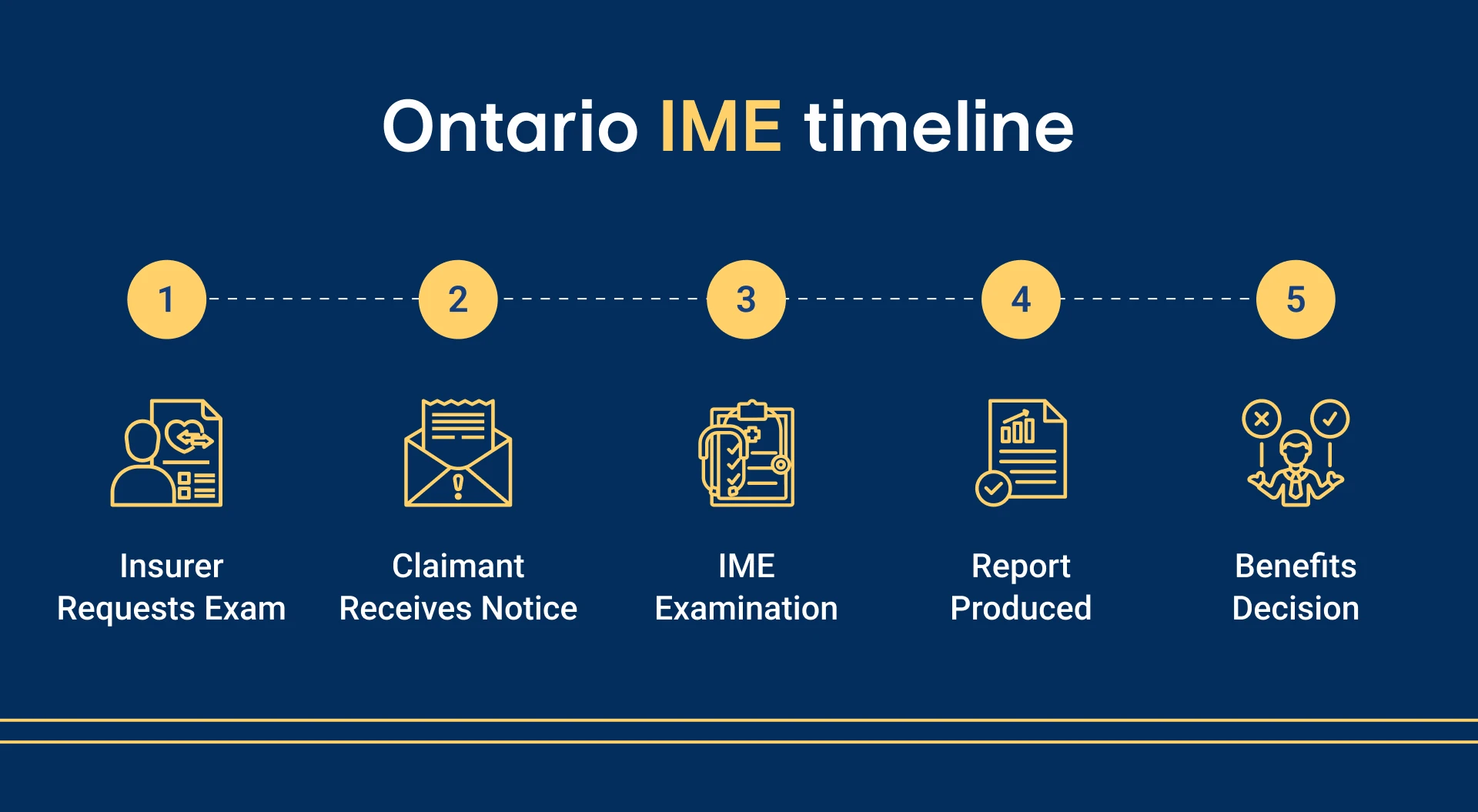
An independent medical examination in Ontario accident benefits is a medical assessment arranged and funded by the insurer under section 44 of the Statutory Accident Benefits Schedule (SABS). Its stated purpose is to assess the nature and extent of the claimant’s injuries. In practice, the report produced is frequently used to challenge, reduce, or terminate benefits the claimant is receiving or has applied for.
This article covers:
- What an IME actually is: The legal basis and how the process operates in Ontario
- Your rights and obligations: What you must do and what you are entitled to decline
- What to bring and how to prepare: Practical guidance for the day of the exam
- How IME reports are used against claimants: The patterns counsel sees most often
- How a personal injury lawyer protects you: Strategic intervention before, during, and after
Quick Facts: Independent Medical Exams in Ontario Accident Benefits Claims
| What You Need to Know | What It Means for Your Claim |
| Legal authority | Section 44 of the SABS permits insurers to require insured persons to submit to examinations for the purpose of determining entitlement to benefits |
| Who pays the examiner | The insurer selects and pays the examining practitioner; the examiner has no treating relationship with you and does not act in your interest |
| Notice requirement | The insurer must provide reasonable notice; you are entitled to know the purpose, the examiner’s specialty, and the areas to be assessed |
| Your right to the report | You are entitled to receive a copy of the completed IME report; your counsel should request it immediately upon completion |
| Consequences of non-attendance | Unreasonable refusal to attend a properly requested section 44 examination can result in suspension of benefits; your lawyer can advise whether a request is properly made |
| Limitation on frequency | Insurers may not require an insured person to attend the same type of examination more than once in a 12-month period, absent special circumstances |
| IME vs. treating physician | A one-time examination by an insurer-paid assessor carries less clinical weight than months of documented treatment by practitioners who have observed you over time |
What Is the Legal Basis for an IME in Ontario and When Can Insurers Request One?
The Statutory Framework: Section 44 of the SABS
Ontario’s Statutory Accident Benefits Schedule governs no-fault accident benefits available to persons injured in motor vehicle accidents. Section 44 of the SABS grants insurers the right to require an insured person to be examined by a practitioner chosen and paid by the insurer. The examination must be connected to the purpose of determining entitlement to, or the amount of, a specific benefit.
The insurer’s right under section 44 is not unlimited. A request made with no stated benefit purpose, or one that amounts to a general reassessment of the entire file without connection to a specific claim, can be challenged. The personal injury lawyers at Zayouna Law Firm (zaylaw.com/personal-injury-law) can review any IME request before you attend to confirm it is properly made.
When Insurers Use IMEs in Practice
In practice, insurers use section 44 examinations at predictable stages of an accident benefits file:
- When a claimant applies for medical and rehabilitation benefits beyond the Minor Injury Guideline limit, to assess whether the injuries fall within or outside the MIG
- When a claimant applies for attendant care benefits, to assess whether the care claimed is medically supported
- When a claimant applies for income replacement benefits beyond the initial period, to assess ongoing disability
- When a claimant seeks a determination of catastrophic impairment, to provide the insurer’s competing assessment
- When the insurer is considering terminating ongoing benefits, to justify a denial based on an assessor’s opinion
Who Conducts IMEs and What Is Their Role?
IMEs in Ontario are conducted by regulated health professionals, typically physicians, psychologists, physiotherapists, or occupational therapists, depending on the type of benefit in dispute. Many assessors conduct insurer IMEs as a significant or primary part of their professional practice. They are paid by insurers on a fee-for-service basis.
This does not mean every IME examiner produces inaccurate reports. It is, however, an institutional reality of the Ontario accident benefits system that IME reports produced by insurer-retained assessors tend to document less impairment and reach conclusions more favourable to the insurer than reports produced by treating practitioners who have observed the patient over time. Understanding this dynamic is part of managing your claim effectively.

What Should You Bring to an IME and How Should You Prepare?
Before the Examination: Notify Your Lawyer First
| BEFORE YOU GO: If you have retained personal injury counsel, do not attend an IME without first speaking with your lawyer. Your legal team can review the request, brief you on what to expect, and advise on how to conduct yourself during the examination. |
What to Bring to the Examination
- Your health card and any identification specified in the notice
- A complete list of your current medications, including dosages and prescribing practitioners
- A list of all treating healthcare providers since the accident: names, specialties, and approximate treatment dates
- Any assistive devices you regularly use (cane, brace, splint, hearing aid, etc.); bring them and use them as you normally would
- A support person if you require one; Ontario practice generally permits a companion to attend as an observer
- A written summary of your daily symptoms and functional limitations, prepared in advance with your lawyer
How to Conduct Yourself During the Examination
Your conduct during an IME is part of the evidentiary record. Assessors observe not just what you say but how you move, how you sit, and whether your reported limitations are consistent with observed behaviour. The following principles apply:
- Be honest and accurate about your symptoms and limitations; do not understate or exaggerate
- Describe your worst days, not your best days, when asked about your typical function; most people experience fluctuating symptoms and should convey the full range
- Do not attempt physical manoeuvres during the exam that you would not perform on a typical day at home
- If a question is unclear, ask for clarification before answering
- You may decline any manoeuvre that causes you pain or that your treating physician has advised you to avoid; state your reason calmly
- Note how long the examination actually lasts; discrepancies between reported and actual examination duration are a documented issue in Ontario IME practice
After the Examination: What Happens Next
Following the IME, the assessor delivers a report to the insurer, who is then required to provide you with a copy. Your legal counsel should review the report immediately to identify inaccuracies, omissions, or conclusions inconsistent with the evidence from your treating practitioners.
Where the insurer relies on an IME report to deny or reduce benefits, your lawyer can respond with counter-evidence from your treating team, retain a rebuttal assessor, or challenge the decision at the Licence Appeal Tribunal (LAT), where Ontario accident benefits disputes are adjudicated. Contact Zayouna Law Firm for a free consultation at zaylaw.com/contact-us.
How Are IME Reports Used Against Injured Claimants in Ontario?
The Most Common Patterns Counsel Sees at the LAT
| Common IME Conclusion | How It Is Used and How It Can Be Challenged |
| Injuries classified within the Minor Injury Guideline | Used to cap medical and rehabilitation benefits at $3,500. Challenge with clinical evidence of chronic pain, psychological injury, pre-existing conditions, or neurological findings that remove the claim from the MIG. |
| Medical and rehabilitation benefits deemed unnecessary | Used to deny specific treatment claims. Challenge with treating practitioner reports establishing clinical necessity and functional relevance of the recommended treatment. |
| Attendant care needs understated or denied | Used to reduce or deny attendant care benefits. Challenge with a Form 1 Assessment of Attendant Care Needs completed by your own occupational therapist. |
| Income replacement benefits terminated | Report concludes claimant is capable of suitable employment. Challenge with updated medical and functional capacity evidence from treating and independent assessors. |
| Catastrophic impairment denied | Has major financial consequences given the difference in benefit limits. Challenge with comprehensive neuropsychological, physiatry, and psychiatric evidence supporting the designation criteria. |
How Legal Counsel Protects You Throughout the IME Process
Experienced personal injury counsel engages with the IME process at every stage. Before the examination, your lawyer reviews the section 44 request for compliance, briefs you on what to expect, and coordinates with your treating team to ensure the clinical record is fully current before you are assessed.
After the report is received, counsel analyses it against the full medical record and advises on the appropriate strategic response. Where a report is used to deny benefits, counsel can challenge it at the LAT with counter-evidence, cross-examination of the assessor, and opinion evidence from practitioners who have treated you over time.
Frequently Asked Questions

In most cases, yes. Section 44 of the SABS gives insurers the right to require you to attend. Unreasonable refusal can result in suspension of benefits. However, not every IME request is properly made. Before you attend, consult a personal injury lawyer who can review the request and confirm it complies with SABS requirements. Zayouna Law Firm offers free consultations at zaylaw.com/contact-us.
Generally, yes. Ontario practice generally permits an insured person to have a support person present at an IME as an observer. Notify the insurer in advance that you intend to bring someone. The support person should not intervene in or direct the examination. Speak with your lawyer beforehand about the appropriate role of any companion.
A conclusion that your injuries fall within the Minor Injury Guideline is used to cap your medical and rehabilitation benefits. This conclusion can be challenged with evidence from your treating physicians, psychologists, and other healthcare providers documenting conditions such as chronic pain, psychological injury, or a pre-existing condition aggravated by the accident. A personal injury lawyer can assess the strength of that evidence.
There is no absolute time limit. Requests are most common when benefits are first claimed, when the claim approaches the MIG limit, or when the insurer is considering terminating ongoing benefits. The insurer is limited to one examination of the same type per 12-month period absent special circumstances.
A section 25 assessment is initiated by the insured person through a treatment provider to support a benefit application. A section 44 IME is initiated and paid for by the insurer. Both types of assessments can be used as evidence at the LAT. The practical difference is that section 25 assessments are produced by practitioners working in your interest, while section 44 IMEs are produced by practitioners retained by the insurer.
If you have been asked to attend an IME or received an adverse decision following one, Zayouna Law Firm offers free consultations for injured Ontarians. We represent accident benefits clients across Ontario.



Leave A Reply